Meet Henri de Lubac by Rudolf Voderholzer
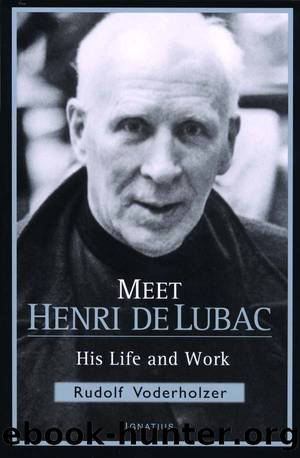
Author:Rudolf Voderholzer [Voderholzer, Rudolf]
Language: eng
Format: epub
Tags: Spiritual & Religion
ISBN: 9781586171285
Publisher: Ignatius Press
Published: 2007-11-30T06:00:00+00:00
The Discovery of God
âTo my believing friends, including those who believe that they do not believe.â So reads the dedication that de Lubac placed at the beginning of the first two editions of his book De la connaissance de Dieu (1945, 1948). The book was revised and expanded several times and now is available in English under the title The Discovery of God. Together with The Drama of Atheist Humanism and the later study on Nietzsche, it contains de Lubacâs most important reflections on the question of God. De Lubac did not intend to write a textbook on the subject. His concern, as the dedication already makes clear, is to lead people to the faith and to accompany them along the way of faith.
Can Godâs Existence Be Proved?
Catholic theology has always insisted that the knowledge of God does not first come to man through the historical revelation of the Word of God. In the Letter to the Romans, Paul writes that ever since the creation of the world, the invisible reality, eternal power and divinity of God the Creator can be recognized from the works of creation with the aid of reason (Rom 1:19-20). The proof of the existence of God takes its classical form in the quinque viae, the five ways, of Thomas Aquinas (Summa theologiae I, 2, 3), five arguments demonstrating that God exists. The first and simplest way concludes from the existence of movement that there is a final unmoved Mover, which is not just another link in this chain of movements, but rather their basis. And this isâas Thomas says at the conclusion of each of the five waysâwhat we call God. The First Vatican Council, citing Saint Paul, declared that God âcan be known with certitude by the natural light of human reason from created thingsâ (DH 3004 [Dogmatic Constitution concerning the Catholic Faith, chapter 2.1]).
Perhaps because of the aphoristic style of the presentation in De la connaissance de Dieu (pp. 35-66; see DG), de Lubac has been accused of bordering on agnosticism1 (see ASC, p. 81). Yet de Lubac is by no means intent on abandoning the proof of the existence of God or promoting some sort of irrationalismâquite on the contrary. Together with the entire Tradition of Catholic theology, he means to uphold the capability of the human mind to know God. God is not merely a matter of opinion, with some people considering the idea that there is a God a good thing, and others not. The positions of acknowledging the existence of God and denying it have not reached a stalemate, leaving nothing but an arbitrary decision for one of the two possibilities. Belief in God can be supported by incisive reasoning. De Lubac regards the proofs for the existence of God as subsequent systematic expressions of an original, spontaneous recognition of Godâs presence.
The classical proofs (of Thomas Aquinas) for the existence of God are based on the principle of causality.2 This very principle was limited by Kant to empirical realityâthat
Download
This site does not store any files on its server. We only index and link to content provided by other sites. Please contact the content providers to delete copyright contents if any and email us, we'll remove relevant links or contents immediately.
Professional Troublemaker by Luvvie Ajayi Jones(29744)
Empire of the Sikhs by Patwant Singh(23188)
Twilight of the Idols With the Antichrist and Ecce Homo by Friedrich Nietzsche(18760)
Plagued by Fire by Paul Hendrickson(17527)
The Sun and Her Flowers by Rupi Kaur(14617)
Norse Mythology by Gaiman Neil(13551)
Fangirl by Rainbow Rowell(9447)
A Journey Through Charms and Defence Against the Dark Arts (Harry Potter: A Journey Throughâ¦) by Pottermore Publishing(9333)
Adultolescence by Gabbie Hanna(9014)
Wonder by R.J. Palacio(8699)
Tools of Titans by Timothy Ferriss(8579)
Becoming Supernatural by Dr. Joe Dispenza(8361)
How to Bang a Billionaire by Alexis Hall(8266)
Wonder by R. J. Palacio(8226)
Crystal Healing for Women by Mariah K. Lyons(8000)
The Road Less Traveled by M. Scott Peck(7721)
The Lost Art of Listening by Michael P. Nichols(7608)
The Witchcraft of Salem Village by Shirley Jackson(7423)
The Institute by Stephen King(7147)
